Loading…

Courtyard Review: Odds, Payouts and What It Really Returns
Cash card rip packs · vaulted, graded, ship or sell back
Loading…
Cash card rip packs · vaulted, graded, ship or sell back
Not yet verified: payment methods, min buy-in, deposit fees, withdrawal fee, payout method, payout speed.
By Lars Langenstueck · Founder, RipRanks · Last reviewed 2026-08-28 · Updated 2026-09-11 · Measured through 2026-09-05
Courtyard is a cash-based card-rip site built on a vault: you buy a pack in US dollars, it reveals a professionally graded card (PSA or CGC) that sits insured in Courtyard's vault as an on-chain token, and you can either ship the physical card to yourself or sell it back for cash. Packs run from $10 to $15,000 across 94 machines — Pokémon, One Piece, Magic, the major sports, plus comics and watches.
Every pack publishes a “pack odds” table — the chance of landing in each dollar-value bucket — and, unusually, Courtyard also publishes a live pull feed where each revealed card carries a fair-market value estimate. That combination makes it the most independently checkable operator we track: you can weigh the advertised odds against the values actually coming out of packs.
The catch isn't hidden odds — it's what “value” means. The headline expected value is roughly the market price of the card you win, which you only fully realize by shipping and reselling the card yourself. Sell it straight back to Courtyard and you take the published ~85% buyback — the cost of instant cash rather than shipping and reselling the card yourself.
Every category we have a real sample for, deepest first, with what those packs returned across the reveals we recorded.
Every pack we have a large enough sample for, richest first. “Typical” is the median pull against the pack price — what a middling open looks like, as opposed to the average, which a single grail can lift on its own.
| Pack | Price | Measured return | Typical | Pulls |
|---|---|---|---|---|
| Pokémon Starter PackBest so far: Charizard · $368 | $25 | 131.6% | 1.11x | 39,671 |
| Wildcard Basic PackBest so far: Boa Hancock · $191 | $15 | 123.5% | 0.97x | 22,474 |
| Pokémon Pro PackBest so far: Dark Persian · $797 | $50 | 114.6% | 1.02x | 17,616 |
| Pokémon Master PackBest so far: Glaceon · $698 | $100 | 100.8% | 0.91x | 10,516 |
| Wildcard Starter PackBest so far: Lionel Messi · $345 | $25 | 129.0% | 1.19x | 8,952 |
| Sports Starter PackBest so far: Victor Wembanyama · $399 | $25 | 148.2% | 1.20x | 8,483 |
| Sealed Pokémon BoosterBest so far: Dragon Majesty (1 Booster Pack - Art May Vary) · $94 | $15 | 107.4% | 0.76x | 7,535 |
| Wildcard Pro PackBest so far: Jean Ratelle · $317 | $50 | 104.4% | 0.89x | 5,582 |
That places Courtyard second of the 19 operators we currently measure, ranked the same way every board on this site is — on the average return across every recorded rip. These come from 217,471 reveals we recorded from Courtyard's public feed — not from odds it advertises. How we measure.
Showing the 8 deepest samples of 97 measured packs — see them all.
You pay in dollars and open a pack, which reveals one graded card (PSA or CGC). The card is already vaulted and insured, held as an on-chain token that represents the physical slab. From there you have two choices: ship the physical card to yourself, or sell it back to Courtyard for cash. You can also list it on Courtyard's marketplace, which charges 0% seller fees.
Because the cards are pre-vaulted, what you're really buying is a randomized claim on a specific pool of graded cards — Courtyard shows the “heavy hitters” (top cards) that are actually sitting in each pack's inventory, not just abstract tiers.
Courtyard publishes one odds set per pack as USD value buckets — for example a $100 Pokémon pack might show a ~52% chance of a $70–85 card down to a ~0.2% chance of a $400–1,600 card — and those buckets sum to 100%. There is no separate “advertised vs real” distribution, so there's no discrepancy to expose; the odds it shows are the odds it pays.
The honest caveat is bucket width. The top buckets are wide (a single $400–1,600 band spans 4×), and within any band the cards skew toward the floor, so the midpoint overstates the typical pull. Each pack page also carries a live value distribution — the $25 Wildcard Starter Pack shows 47% of pulls landing in $17.50–21, 33% in $21–25, 18% in $25–50, 2% in $50–100 and 0.1% in $100–400, with the average item value stated as $23.75, or 95% of the pack price. Courtyard's own on-site “expected value” is that same flat 95% of the pack price applied to every pack — a tidy marketing figure rather than one derived from the buckets — so we compute EV from the buckets ourselves.
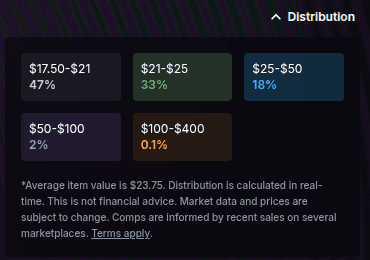
Value-weighting the published buckets at their midpoints gives a gross expected return of 96.3–118.8% of the pack price, median 100.9%, depending on the pack. That gross number is what the card you win is estimated to be worth — realizable in full only if you ship the card and resell it yourself.
The realizable-in-cash number is lower. Courtyard's published buyback ratio is about 85% (0.846), so selling a won card straight back returns 81.4–100.5% of the pack price across the catalogue, median 85.3%. That spread — gross if you ship, ~85% of it if you cash out instantly — is the clearest picture of the true cost of playing, and Courtyard is one of the few operators that gives you both numbers.
Courtyard pays in cash, and their API publishes a buyback ratio of 0.846 — the figure their own expected-value maths runs on. In the product it is called a Liquidation Offer, and the dialogue is more candid than the number suggests: offers are "valid only at the time of request and may change over time (from 50% to 100% of FMV) to reflect real-time supply and demand." So 84.6% is the planning figure, not a floor. Alternatively you ship the physical graded card (shipping costs apply) and keep the full value, or list it on the marketplace at 0% seller fees. Vault storage and insurance are handled by Courtyard while the card sits on-platform.
The buyback is the number that matters for a quick flip: it is the discount you accept to turn a card into money without waiting for a sale. At ~85% it's transparent and competitive, but it's still the house's margin on a cash-out.
I funded the account with a credit card rather than crypto, which settles a question our own page used to get wrong: you do not need to arrive with a wallet. Courtyard's card deposit runs through Banxa, powered by Unifold, quotes in euros as well as dollars, and states an estimated delivery time of under a minute. It behaved like any other card checkout.
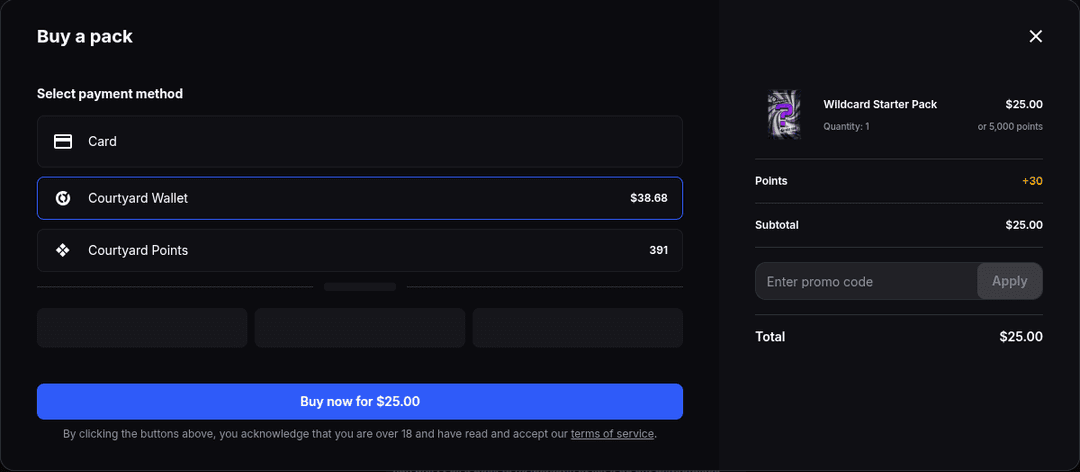
At the pack itself there are three ways to pay — card, your Courtyard balance, or Courtyard Points, where a $25 pack costs 5,000 points. A purchase that size earns 30 points back, so points are a slow loyalty drip rather than a second currency, but they do buy packs outright. There is a promo code field at checkout, and you can buy up to five of the same pack in one go.
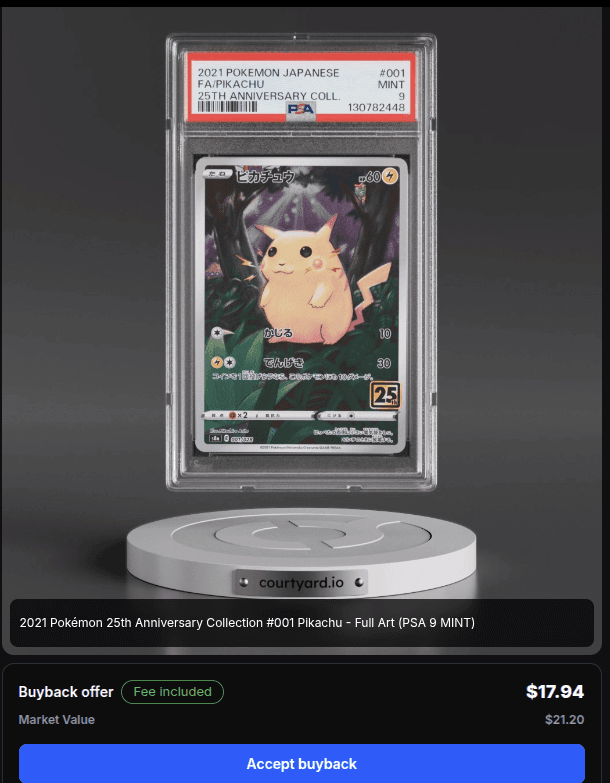
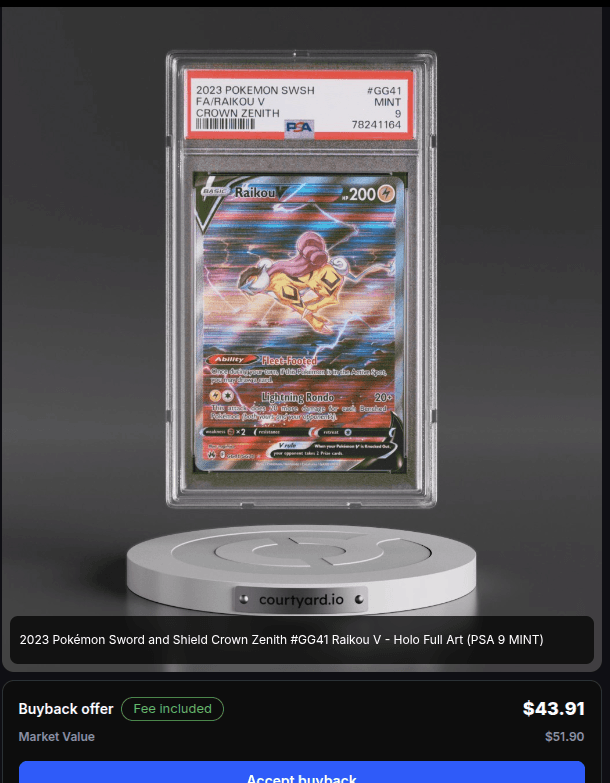
The sell-back is quoted openly, which is the part worth seeing. Every buyback screen puts the card's market value and the offer side by side, with a "fee included" badge on the offer. Two pulls from the same $25 Wildcard Starter Pack, back to back: a PSA 9 Pikachu at a $21.20 market value offered at $17.94, then a PSA 9 Raikou V at $51.90 offered at $43.91. A third, on a One Piece card, came in at $15.72 against $18.50.
That is 84.6%, 84.6% and 85.0% — three for three within half a point of the 0.846 ratio their API publishes. It is also the honest shape of this in two rips: the first card came back under the price of the pack, the second at better than twice it.
Worth reading the small print anyway. The liquidation dialogue states that offers are "valid only at the time of request and may change over time (from 50% to 100% of FMV) to reflect real-time supply and demand." We have not seen it move — but the range they reserve is far wider than the rate they have actually paid, and on an illiquid card there is nothing stopping it.
One thing to plan for: you can deposit and rip without identity verification, but withdrawing requires KYC. It is the kind of step people meet at the moment they want their money rather than at the start.
Courtyard delivers real, professionally graded cards from an insured vault, publishes its odds and its buyback rate openly, puts a value on every pull in a public live feed, and runs a 0%-fee marketplace. On transparency it's the strongest operator we rate. The thing to understand — not a scam, just economics — is that the attractive gross expected value is only fully captured by shipping and reselling; the instant cash-out applies a ~15% haircut.
That's our read on Courtyard. Their odds, packs and terms are theirs to change — worth a look before you rip.
Yes — Courtyard vaults and ships real PSA/CGC-graded cards, publishes its pack odds and its buyback rate, and shows a fair-market value on every pull in a public feed. It's the most transparent operator we track.
At the published value-bucket midpoints the gross return runs 96.3–118.8% of the pack price, median 100.9%. If you sell the card straight back rather than shipping it, Courtyard's ~85% buyback drops the realizable return to 81.4–100.5%, median 85.3%.
Their API publishes a ratio of 0.846, and a Liquidation Offer we recorded first-hand came in at exactly 85.0% — $15.72 against an $18.50 fair market value. The offer dialogue itself says offers range from 50% to 100% of FMV depending on real-time supply and demand, so treat 85% as the typical case rather than a fixed rate.
Yes. You can sell a won card back to Courtyard for cash at ~85% of its estimated value, ship the physical graded card and keep full value, or list it on Courtyard's marketplace at 0% seller fees.
No — it publishes one value-bucket odds distribution per pack, the buckets sum to 100%, and the odds shown are the odds paid. It also publishes a live pull feed with a value on each card, so the odds are independently checkable.